Thinking of taking the leap and moving abroad?
As a child I travelled the world through the means of my parents’ jobs and this feeling of moving around also remained with me as the norm and something I had always dreamed of doing when I got older.
Welcome to a world of limitless possibilities, where the journey is as exhilarating as the destination, and where every moment is an opportunity to make your mark on the canvas of existence. The only limit is the extent of your imagination.
Deciding if its right for you
Determine your ‘why’
- Ok, with this one I’m very fortunate to be working in an industry where I travel a lot for work, which means hotel points and frequent flyer points, but there’s still lots of ways you can point hack
- Credit card flipping is a good way to rack up lots of frequent flyer points. If you’re living in Australia, OzBargain Credit Cards is a good way to look at what points deals are out there, i.e. if you sign up to the card you spend $3000 in 90 days to receive 100,000 Qantas points etc.
- NOTE: MAKE SURE YOU PAY OFF YOUR CREDIT CARD AMOUNTS IN FULL NOT TO INCUR INTEREST AND READ THE TERMS AND CONDITIONS! Also be aware if you’re looking to buy a house, this can mess up your credit rating, so again take this tip with caution
- Booking Classic Rewards flights with Qantas. This honestly has saved me THOUSANDS in the past few years as I’ve booked numerous overseas flights using Classic Rewards. You have to be a bit flexible on location and date, but usually you can make it work. i.e. I booked my Latin America trip (Melbourne to Santiago and Los Angeles to Melbourne) with only 90,000 points and taxes of $200 AUD, this saved me around $3000 AUD, beaut
- I tend to stay in hostels on long backpacking trips, but for locations which hostels were $100 AUD+, using my Hyatt points saved me a lot. Try and stick with 1 hotel chain, and rack those points up…
Consider costs
- I’ve booked a 1 way flight with no plans in the past, and although I enjoy the freedom, planning out a little in advance makes the experience much more smooth and you get to see a whole lot more!
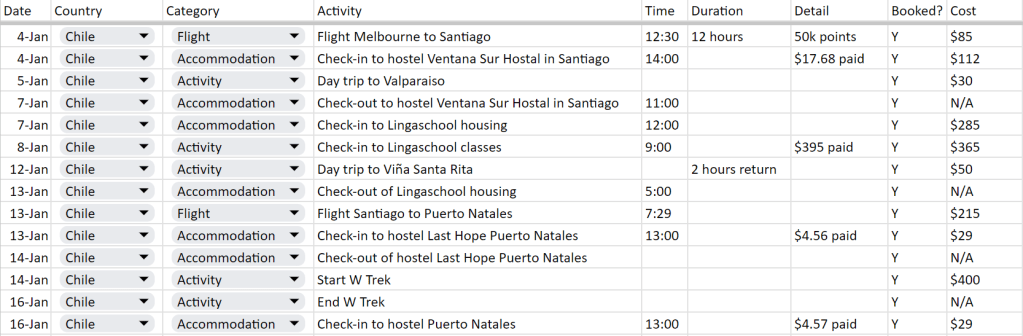
- My preferred methodology is to create a rough outline of where I want to go, what I want to do and anything I’ve pre-booked in an Excel style sheet using Google Sheets (so you can share it with anyone you’re travelling with)
- I usually figure out how many nights I want to stay in a place, and add in buffer days after big activities (i.e. a hike)
- For longer trips, where I needed to budget a little more carefully and make my money stretch, this was extremely useful
- An example of my plan for the Chile segment of South America is included below
Tip 3. Work out your budget
- Very useful for both long and short trips, but always make sure you add some buffer in (i.e. for ATM fees, unexpected charges etc.)
Start out with the big costs i.e. flights, hotels, buses etc - Add in any big activities you want to do i.e. if you’re doing any tours or want to buy tickets to anything expensive
- Figure out any pre-departure costs, i.e. vaccinations, travel insurance, visa costs
- Add in your daily food allowance, I try and budget for $30 AUD per day on budget trips (realistically some days I eat very little while travelling, and other days I dine out at nice restaurants, which averages out)
- Add in some extra cash for fun spending, i.e. souvenirs, clothes, etc…
 Mon's Voyage